
Broker dealers can prepare for a more efficient annual audit by organizing documentation early, reviewing regulatory reports, confirming internal controls, and communicating with their audit team before fieldwork begins. A well-prepared audit process helps reduce delays, avoid last-minute requests, and support more accurate financial reporting.
EWA provides specialized broker dealer audit services for firms operating in a highly regulated environment, including requirements involving the SEC, FINRA, and PCAOB standards that may apply to broker dealer annual audits.
Understand the Annual Audit Requirement
Broker dealers should begin audit preparation by understanding the annual reporting and audit requirements that apply to their firm. These requirements are designed to support investor protection, regulatory compliance, and reliable financial reporting.
Under SEC Rule 17a-5, broker-dealers registered under Section 15 of the Securities Exchange Act of 1934 are required to file annual reports with the SEC. Beginning June 30, 2025, Form X-17A-5 Part III annual reports must be filed electronically through the SEC’s EDGAR system rather than by paper or email. Firms should confirm their current SEC filing procedures and organize required documentation well before the filing deadline. Review the SEC’s current electronic filing guidance.
EWA has worked with broker dealers for decades and understands that audit preparation is not only about compliance. It is also about making the process efficient, accurate, and less disruptive for management and operations teams.
Start Preparing Before Year-End
Broker dealers should not wait until year-end closes to begin audit preparation. Many audit delays happen because documents are incomplete, reconciliations are not current, or staff members need time to research prior transactions.
A smoother process begins with a calendar. Management should identify key audit dates, internal close deadlines, document request timelines, and the employees responsible for each section. This helps the firm avoid bottlenecks during fieldwork.
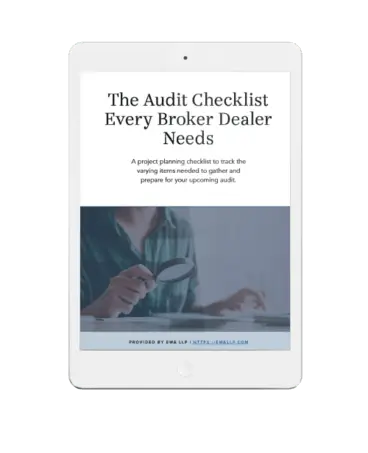
For a practical way to organize the preparation process, broker dealers can also download EWA’s Broker Dealer Audit Checklist to help identify key documents, reporting items, and other areas to review before the audit begins.
Preparation should also include early discussions about changes during the year. New business lines, regulatory matters, accounting changes, staffing changes, capital activity, or operational updates may affect audit planning and documentation needs.
Organize Core Financial Records
Broker dealers can improve audit efficiency by keeping core financial records complete, reconciled, and easy to access. Auditors need support for balances, transactions, disclosures, regulatory reports, and internal control processes.
Common records to organize include:
- Trial balance and general ledger
- Bank statements and reconciliations
- Revenue schedules and supporting documentation
- Expense support and vendor files
- Net capital calculations
- FOCUS report support
- Clearing agreements, if applicable
- Legal, compliance, and regulatory correspondence
- Board or management approvals
- Financial statement disclosure support
When records are prepared in advance, the audit team can spend less time following up on missing items and more time completing audit procedures efficiently.
Review Net Capital and Regulatory Reporting Support
Broker dealers should review net capital calculations and regulatory reporting support before audit fieldwork begins. These areas are often central to the audit because they connect financial statement information with regulatory compliance.
Management should confirm that calculations are complete, supported, and consistent with the firm’s books and records. Any unusual items, adjustments, or changes from prior periods should be documented clearly.
This preparation also helps reduce questions later in the audit. If explanations are available upfront, the process becomes more organized and less reactive.
Audit Preparation Checklist for Broker dealers
| Preparation Area | What to Review Before the Audit |
| Financial records | Trial balance, general ledger, reconciliations, and supporting schedules |
| Regulatory reports | FOCUS report support, net capital calculations, and related documentation |
| Revenue | Commission, advisory, trading, or other revenue support, depending on business model |
| Expenses | Vendor invoices, payroll support, professional fees, and operating costs |
| Disclosures | Financial statement notes, commitments, contingencies, and related-party matters |
| Compliance | Regulatory correspondence, examination results, and management responses |
| Internal controls | Approval processes, reconciliations, segregation of duties, and review procedures |
| Audit coordination | Request list ownership, deadlines, and communication with the CPA team |
Confirm Financial Statement Disclosures
Broker dealers should review financial statement disclosures before the audit because disclosures often require detailed support. Missing or unclear disclosures can create delays even when the numbers are accurate.
Disclosure areas may include related-party transactions, commitments and contingencies, revenue recognition, clearing arrangements, subsequent events, and regulatory matters. If the firm had operational changes during the year, disclosures may also need to be updated.
EWA’s broader audit services are designed to support clear reporting, compliance, and confidence in financial information. For broker dealers, that clarity is especially important because audit reports, regulatory filings, and financial statement presentation are closely connected.
Communicate Changes Early With the Audit Team
Broker dealers should tell their audit team about major changes before fieldwork begins. Early communication helps auditors plan the engagement, identify higher-risk areas, and request the right documentation sooner.
Examples of changes to discuss include new revenue streams, changes in clearing relationships, ownership changes, capital contributions, regulatory inquiries, business model changes, or accounting policy updates. These items may affect audit procedures, disclosures, and management representation.
Early communication also helps prevent surprises near filing deadlines. If an issue needs additional analysis, management has more time to gather information and respond.
Learn From Prior-Year Audit Requests
A broker dealer can often make the current audit smoother by reviewing the prior-year request list and audit comments. Recurring requests give management a practical starting point for current-year preparation.
If certain items caused delays in the prior year, those should be addressed earlier this time. For example, if revenue support, reconciliations, disclosure schedules, or regulatory documentation took longer than expected, management can prepare those files before the audit begins.
EWA’s related blog on how to have a positive broker dealer audit experience also emphasizes the value of preparation, documentation, and communication. These habits can make the audit process more predictable for both the firm and the audit team.
Assign One Audit Point Person
Broker dealers should assign one internal point person to manage audit requests. This helps keep communication organized and reduces the chance that requests are missed, duplicated, or answered inconsistently.
The point person does not need to answer every technical question alone. However, they should track open items, coordinate with management, follow up with staff, and keep the audit timeline moving.
A centralized process is especially useful when finance, compliance, operations, and leadership all need to contribute information. Clear ownership can make the difference between a stressful audit and a more efficient one.
Final Thoughts
Preparing for an upcoming broker dealer audit? Contact Ernst Wintter & Associates LLP to learn how our broker dealer audit services can help your firm prepare, stay organized, and move through the audit process with greater confidence.
A more efficient broker dealer audit begins with early preparation, organized documentation, and clear communication. When financial records, regulatory reporting support, disclosures, and internal controls are reviewed before fieldwork, the audit process can move more smoothly.
Ernst Wintter & Associates LLP helps broker dealers prepare for annual audits with industry-specific experience and a practical understanding of regulatory reporting needs. With the right preparation, firms can reduce audit delays and approach the annual audit with greater confidence.